In the world of commercial lighting, understanding the differences between various high bay options is crucial. One common question arises: "What is the difference between UFO high bay and linear high bay?" According to the Lighting Research Center, industrial settings prefer high bay lights due to their efficiency and performance. UFO high bays, with their round design, offer widespread illumination and efficient heat dissipation. Meanwhile, linear high bays tend to spread light more directionally, making them ideal for long aisles and narrow spaces.
Data from industry reports indicate that UFO high bays often consume 30% less energy than their traditional counterparts. This efficiency is essential for businesses looking to reduce operational costs. On the other hand, linear high bays may utilize advanced optics to achieve specific lighting requirements, which may lead to over-specialization. This can result in increased costs for installation and maintenance.
Both types of high bays have their unique benefits and limitations. For instance, UFO models are easier to install in certain environments. However, linear designs can offer flexibility in layout configurations. It's important for businesses to evaluate their specific needs carefully. Choosing the right lighting solution can impact energy savings, maintenance, and overall operational efficiency.
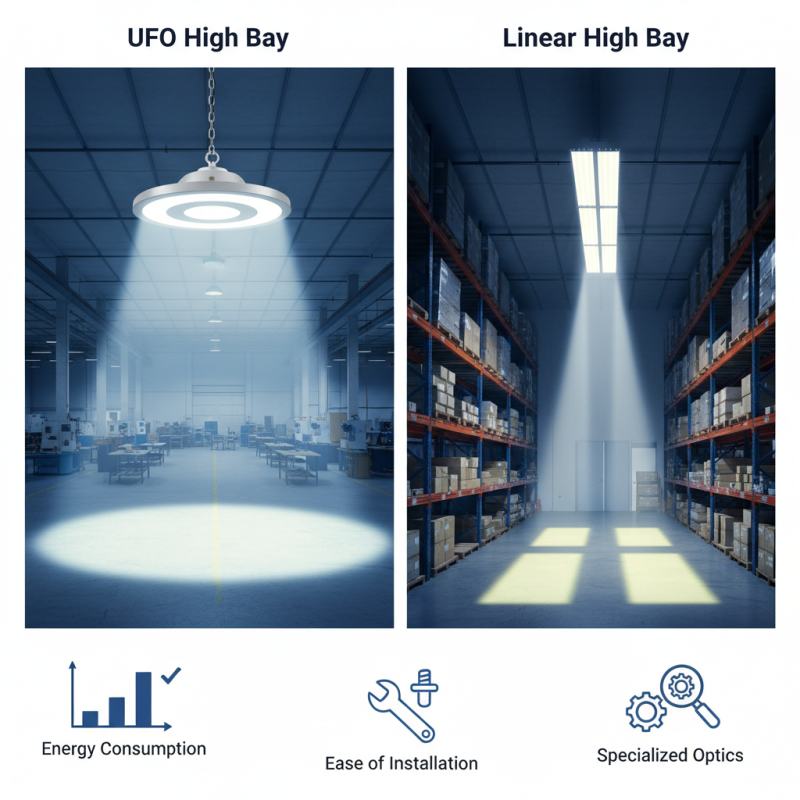
Definition of UFO High Bay and Linear High Bay Lighting
UFO high bay and linear high bay lights are popular options for industrial and commercial spaces. UFO high bays feature a circular design, resembling a UFO. This shape allows for more effective light distribution over a wide area. The compact design often results in higher lumen outputs, making them suitable for large warehouses or gymnasiums.
In contrast, linear high bay lights take a more elongated form. They can provide uniform lighting along aisles or workspaces. This design is practical for areas requiring consistent illumination, such as assembly lines. Linear fixtures can be suspended or mounted directly to ceilings. Both types are energy efficient but differ in their installation and application suitability.
Installation can be tricky for both designs, depending on ceiling heights and layout. UFO lights might not fit every aesthetic. Likewise, linear lights can be more complex to wire. Reflecting on these differences can help buyers choose the right lighting for their needs. Evaluating specific areas or tasks will lead to smarter lighting decisions.
Design and Aesthetic Variations Between UFO and Linear High Bay
When comparing UFO high bay lights to linear high bay models, design and aesthetics play a significant role.
UFO high bays are spherical in shape, often resembling flying saucers. This unique look can add a futuristic touch to industrial spaces. They generally provide a more focused light spread, which can highlight specific areas effectively.
On the other hand, linear high bays feature a sleek, elongated design. This style can blend seamlessly with modern architecture. Their extended form allows for broader, uniform lighting across larger areas. Various color finishes are available for both types, enabling customization to suit the space.
Tips: Consider the overall design of your establishment when choosing lights. A UFO high bay can introduce character to a warehouse, while linear fixtures fit well in office environments.
The choice between these two styles should not focus solely on appearance. Functionality matters just as much. Assess the space and lighting needs first. Reflect on how each option will impact the room's ambiance and workflow. A mismatch can lead to a less effective lighting solution.
Light Distribution Patterns: A Comparison of UFO and Linear High Bay
When comparing UFO high bays with linear high bays, light distribution patterns play a critical role. UFO high bays typically use an omnidirectional design, creating a spherical light pattern. This is beneficial for spaces that require uniform illumination across a wider area. The light spreads out in all directions, reducing shadows and enhancing visibility in large environments.
In contrast, linear high bays focus the light in a more directional manner. This design is ideal for elongated spaces, like warehouses or assembly lines. The light beams stretch out, providing concentrated illumination where it is most needed. However, the linear design can lead to uneven lighting, creating areas of brightness and darkness if not placed correctly. Users must consider the specific requirements of their spaces to choose the ideal fixture.
Finding the perfect fit is not always straightforward. Environmental factors may influence performance too. Ceiling heights, beam angles, and mounting positions all come into play. Evaluating these components can help identify an appropriate lighting solution. Ultimately, assessing light distribution patterns is vital for optimal performance in any lighting application.
Top 10 Differences Between UFO High Bay and Linear High Bay
| Feature |
UFO High Bay |
Linear High Bay |
| Light Distribution Pattern |
Omni-directional |
Directional |
| Design |
Circular |
Rectangular |
| Installation Height |
Typically 15-25 feet |
Typically 10-20 feet |
| Ideal Use Cases |
Large Warehouses, Gymnasiums |
Retail, Aisles |
| Lumen Output |
High (up to 30,000 lumens) |
Moderate (up to 20,000 lumens) |
| Energy Efficiency |
High |
Moderate |
| Maintenance |
Easier due to central location |
May require multiple units |
| Cost |
Generally higher |
Generally lower |
| Aesthetic Appeal |
Modern |
Traditional |
| Heat Management |
Good cooling design |
Heat often concentrated |
Installation Differences: UFO High Bay vs. Linear High Bay
When considering installation differences between UFO high bays and linear high bays, several factors come into play. UFO high bays have a round shape, which can simplify the installation process. Their design allows them to focus light downward effectively, making them suitable for spaces with high ceilings. In contrast, linear high bays are elongated and may require more precise positioning. This can lead to increased complexity during installation.
The mounting methods also differ significantly. UFO high bays usually feature a hook or bracket for easy suspension. This is beneficial for warehouse settings where quick installation is essential. On the other hand, linear high bays may need additional hardware for mounting. They often hang parallel to the workflow, necessitating careful alignment.
Electrical connections are another consideration. UFO high bays typically have a simpler wiring layout, which can reduce installation time. Linear high bays may demand advanced wiring and additional safety measures. Less experienced installers might find this challenging. The space's layout can impact installation decisions profoundly. Choose the fixture that aligns with your specific needs.
Top 10 Differences Between UFO High Bay and Linear High Bay
Cost and Energy Efficiency: Analyzing UFO and Linear High Bay Systems
The landscape of industrial lighting is evolving. UFO high bay lights and linear high bay systems each have unique benefits related to cost and energy efficiency. Industry reports suggest that UFO designs are often more efficient due to their round shape, allowing for better light distribution. It has been documented that UFO lights can save up to 25% more energy than traditional linear models under similar conditions.
The initial investment for UFO high bays tends to be higher, but the long-term savings are compelling. A recent study indicated that users can experience a return on investment within two years. Comparatively, linear high bays may come with lower upfront costs, but they often consume more energy over time. Despite this, some facilities prefer linear options for their sleek aesthetic and versatile mounting options.
With ongoing advancements in LED technology, energy requirements are continuously changing. Data shows that both options are making strides. There are still questions about specific use cases. Facilities must weigh the visual comfort and efficiency before making decisions. Each choice has its unique strengths and potential drawbacks. Careful analysis is key to achieving optimal results in lighting design.
FAQS
: UFO high bays are round and simpler to install. Linear high bays require precise positioning.
UFO high bays often use hooks or brackets for easy suspension. Linear high bays may need extra hardware.
Yes, UFO high bays typically have simpler wiring, which can speed up installation. Linear designs may require advanced connections.
UFO high bays are generally more energy-efficient, potentially saving up to 25% more energy than linear models.
UFO high bays often have a higher upfront cost. However, they offer better long-term savings over linear high bays.
Some users prefer linear high bays for their sleek look, despite UFO lights being more efficient.
Yes, the layout can significantly impact which fixture is chosen. It's crucial to match the fixture to specific needs.
Yes, less experienced installers may find the precise alignment and additional hardware needed challenging.
Users can see a return on investment within two years. This makes them compelling despite higher initial costs.
Yes, advancements in LED technology continue to evolve. Both UFO and linear high bays are making progress in energy efficiency.
Conclusion
When considering industrial lighting solutions, a common question arises: "What is the difference between UFO high bay and linear high bay?" This article outlines key distinctions between these two popular lighting options. UFO high bays are typically round and offer a compact design, while linear high bays are elongated and can provide a sleek aesthetic. The light distribution patterns also differ, with UFO high bays generally producing a more concentrated light, whereas linear high bays distribute light more evenly across a wider area.
Installation methods for these two types vary as well; UFO high bays are often easier to mount in spaces with high ceilings, while linear high bays may require more intricate setups. Additionally, a cost and energy efficiency analysis reveals that both systems have their benefits, but energy savings can vary based on specific usage and layout. Overall, understanding these differences can help in choosing the most suitable lighting solution for your facility's needs.
 Suvlux Light
