Artificial light should help people see, not erase the night. Shielded LED fixtures direct illumination toward sidewalks, entrances, and roads. They reduce glare, wasted energy, and bright patches above buildings. This practical approach supports safer movement while protecting nocturnal wildlife and nearby residents.
How to reduce light pollution with shielded LED fixtures? Start with the fixture, not only the lamp. Full-cutoff housings keep light below the horizontal plane. Warm color temperatures, usually 2200K to 3000K, can reduce harsh blue light. Lower lumen output may work better than excessive brightness. Use dimming controls, motion sensors, and timers where constant lighting is unnecessary. A narrow beam can illuminate a doorway without flooding a bedroom window.
John Barentine, an astronomer and former conservation director at the International Dark-Sky Association, has said, “Light pollution is the easiest environmental problem to solve.” His observation remains useful because better design often matters more than brighter equipment. A small test area can reveal problems. Stand across the street at night. Check for glare, upward spill, and dark walking zones. Adjust the angle before adding power. That step is often missed.
No fixture solves every site condition. Trees, reflective walls, weather, and changing traffic can alter results. Measurements should support judgment, not replace it. Responsible projects review nighttime performance after installation. They also listen to residents and maintenance teams. Sometimes, the first design is simply too bright. That is not failure. It is evidence for improvement.
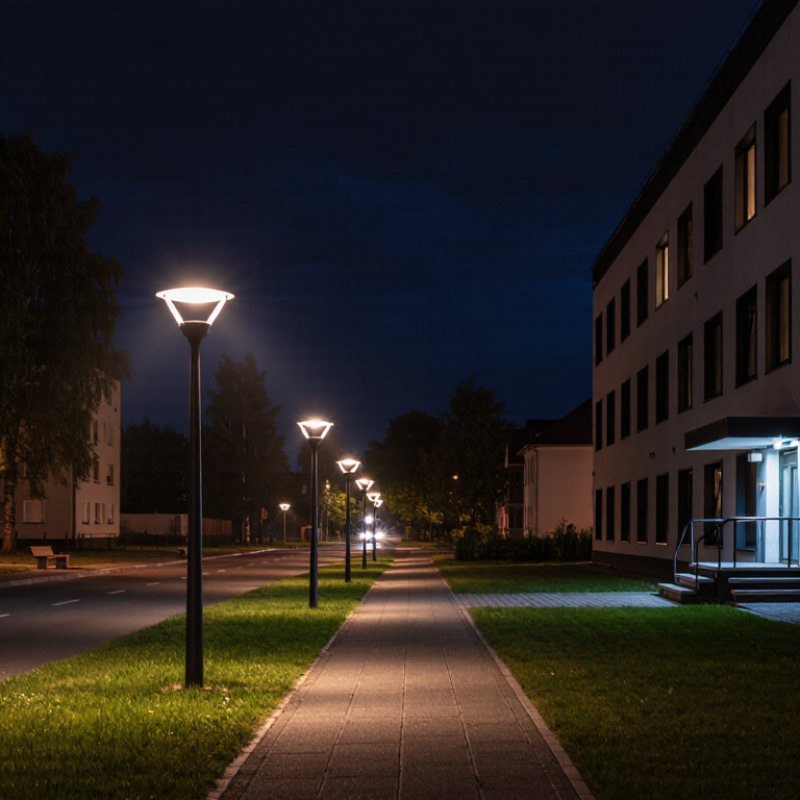
Shielded LED fixtures control where light goes. Their housings use angled visors, flat lenses, or internal cut-off reflectors. These parts direct illumination toward roads, walls, and work areas instead of the sky. The result is less upward glow, reduced glare, and fewer bright patches across nearby windows.
In field evaluations, a well-shielded fixture can make a parking area feel calmer at night. Light stays closer to the pavement. Drivers see fewer harsh reflections on windshields. Residents may also notice less light entering bedrooms. However, shielding alone cannot solve every problem. Poor mounting height, excessive brightness, or a narrow beam can still create discomfort.
When comparing fixtures from China, request photometric files, glare data, and clear installation guidance. Check the beam angle, color temperature, dimming options, and ingress protection rating. A warmer color temperature often feels less intrusive near homes, though site conditions matter. Ask whether testing covers the complete fixture, not only the LED module. This detail is easy to miss. A product may appear efficient on paper but perform poorly after installation. I would also inspect the visor quality, seal strength, and heat management. Small design flaws can shorten service life or scatter light unexpectedly. Good decisions require measurements at the site, not attractive catalog photographs alone.
China’s top shielded LED fixtures focus on controlling light, not merely increasing brightness.
Their key design feature is a precise optical system that sends illumination toward the target area. This reduces upward spill and limits glare near homes, roads, and wildlife zones.
A well-designed fixture often combines a full cutoff housing, deep LED placement, and an adjustable mounting arm. The housing blocks direct views of the light source from normal viewing angles.
A tempered lens can protect the LEDs from rain, dust, and impact. However, clear lenses are not automatically better. Poor lens angles may create bright hotspots on pavement.
Thermal management also matters.
Aluminum housings, internal heat paths, and ventilation details help maintain stable output over time. During fixture evaluations, engineers should check temperature rise after several hours.
A cool-looking unit may still perform poorly under continuous operation. Photometric reports, ingress testing, electrical safety documents, and consistent factory inspection provide stronger evidence than attractive product images.
Some Chinese manufacturers offer modular drivers and selectable color temperatures. These options support different streets, campuses, and industrial areas.
Warmer light can feel less intrusive in residential settings. Lower brightness may also work better than excessive output.
That point is often overlooked.
No shielded design is perfect.
A narrow beam can produce harsh contrast or dark gaps. Installation height, spacing, and nearby reflective surfaces can change the result.
Field testing remains essential before large-scale replacement.
Comparing shielded LED fixtures requires more than checking wattage or advertised brightness. Start with the outdoor application. Parking areas need controlled downward light, while pathways need comfortable visibility without harsh glare. For each fixture, review the photometric file, beam distribution, shielding design, and BUG rating. A lower color temperature, such as 2700K or 3000K, may reduce visual discomfort near homes and natural areas. It can also make surfaces appear less stark at night.
Tips: Request a sample, not only a catalog image. Check the fixture at its actual mounting height. Look for light escaping above the horizontal plane. Confirm IP and impact ratings for rain, dust, and exposed locations. Ask for dimming compatibility, surge protection, driver life data, and consistent color performance. These details matter during installation and maintenance. The cheapest unit may create higher costs if glare complaints require repositioning.
For different applications, compare spacing, pole height, mounting angle, and maintenance access together. A narrow beam may work along a walkway but create bright patches between poles. A wide beam may reduce dark gaps in a parking lot but increase spill light. Review independent test reports and quality-control records when sourcing from China. Do not rely on polished claims alone. Field conditions are messy. Even a technically strong fixture can perform poorly when aimed incorrectly or installed too closely. A small night-time trial often exposes problems that drawings miss.
The chart compares typical maintained horizontal illuminance targets for common outdoor applications. Full-cutoff or fully shielded LED fixtures are generally preferred where uplight, glare, and light trespass must be minimized. The ranges are representative planning benchmarks based on commonly used IES lighting practice; local codes, site conditions, and professional photometric calculations should determine the final design.
China’s shielded LED fixtures should be evaluated through standards, certifications, and measured environmental performance.
A well-designed fixture directs light toward the ground, not bedroom windows or the night sky.
Ask for independent photometric files, glare data, beam angles, and testing under realistic installation conditions.
Shielding alone is not enough.
Check compliance with relevant safety standards, such as IEC 60598-1, and confirm whether China Compulsory Certification applies to the product.
RoHS documentation can clarify restricted substances, while ISO-certified manufacturing systems may support process consistency.
However, a certificate does not automatically prove low light pollution.
Review color temperature, upward light output, flicker, power factor, and expected lumen maintenance. Lower is often better for outdoor environmental impact, but excessive dimming can reduce safety.
Tips:
My evaluation experience suggests installation height and aiming can matter as much as the fixture itself.
This is easy to overlook.
No assessment is perfect; weather, surrounding buildings, and maintenance can change results over time.
Selecting the Right Chinese Manufacturer for Shielded LED Solutions
Choosing a Chinese manufacturer for shielded LED fixtures requires more than comparing price and wattage. The International Dark-Sky Association estimates that about 30% of outdoor lighting is wasted through poor design and unnecessary brightness. A reliable supplier should provide full-cutoff optics, accurate photometric files, and measurable glare control. Ask for IES files, LM-79 test reports, and clear beam-angle data. Photographs are not enough.
Outdoor projects need practical evidence. The U.S. Department of Energy’s solid-state lighting reports document commercial LED products exceeding 150 lumens per watt under suitable conditions. However, fixture efficiency can fall after thermal stress, lens aging, or dirty surfaces. Request LM-80 data for LEDs and TM-21 projections for lumen maintenance. Check operating temperatures, surge protection, IP66 sealing, and corrosion resistance. Small details matter.
Visit the factory virtually or in person. Review optical assembly, driver testing, aging tests, and final inspection records. Ask whether each batch receives photometric verification. A capable manufacturer should explain glare shields, backlight control, and adjustable mounting without vague promises. Dark-sky compliance is not created by a black housing alone. It depends on distribution and installation height.
I would still order samples.
Test them at the planned mounting height, not only on a workbench. Measure spill light near windows, roads, and neighboring properties. Even a well-designed fixture can fail when aimed carelessly. Supplier transparency, repeatable testing, and responsive engineering support often matter more than the lowest quotation.
| Evaluation Dimension | Recommended Screening Benchmark | What to Request from the Manufacturer | Why It Matters for Light Pollution Control | Relevant Reference |
|---|---|---|---|---|
| Optical Shielding | Prefer a full-cutoff or zero-uplight design with no direct view of high-intensity LEDs above the intended cutoff angle. | Photometric files in IES or LDT format, optical drawings, lens specifications, and a statement of uplight performance. | Reduces skyglow, unwanted architectural spill, and direct glare toward nearby properties or road users. | IES TM-15; CIE 150 |
| Uplight Percentage | Target 0% uplight for applications requiring strict control of upward light; verify the value using the complete fixture photometry. | Laboratory photometric report showing total upward light output and the test orientation used. | A zero-uplight target is especially suitable for residential streets, ecological areas, observatories, and dark-sky-sensitive locations. | IES TM-15; CIE 150 |
| Glare Control | Use a recessed LED board, internal visor, louver, or asymmetric optic where low viewing angles may create discomfort glare. | Glare-control drawings, candela distribution curves, installed-height calculations, and field-of-view images. | Shielding must control high-angle brightness, not merely cover the light source from a single viewing direction. | IES RP-8; CIE 150 |
| Color Temperature | Consider 2,200–3,000 K for sensitive outdoor locations; select the lowest practical CCT that meets visual requirements. | Correlated color temperature tolerance, spectral power distribution, and production-batch test records. | Lower-CCT light generally contains less short-wavelength energy, which can help reduce ecological and visual impacts when glare and intensity are also controlled. | CIE 150; local lighting regulations |
| Color Rendering | Specify the minimum CRI and R9 performance according to the application rather than selecting high CRI alone. | Color-rendering test report, chromaticity coordinates, and binning tolerance for LED packages. | Balanced color quality supports recognition and safety while avoiding unnecessary optical output or excessive blue content. | CIE 13.3; IES TM-30 |
| Dimming and Controls | Require programmable dimming, astronomical-clock compatibility, motion sensing, or a compatible control interface where appropriate. | Dimming curve, minimum stable output level, control protocol, wiring diagram, and failure-mode behavior. | Reducing output during low-activity periods can lower energy use and limit unnecessary nighttime light. | Project specification; local energy code |
| Photometric Accuracy | Require test data for the exact optical, electrical, and shielding configuration being quoted. | Accredited laboratory report, test date, luminaire serial reference, and complete IES or LDT file. | Performance claims based only on an LED package or a similar model may not represent the finished shielded fixture. | IES LM-79; ISO/IEC 17025 |
| LED Lifetime Evidence | Evaluate lumen-maintenance projections together with operating temperature, drive current, and warranty terms. | LM-80 test data for the LED package, TM-21 projection, in-situ temperature measurement, and rated-life assumptions. | Stable lumen output helps prevent early replacement and avoids performance changes that may increase glare or energy demand. | IES LM-80; IES TM-21 |
| Thermal Management | Require an aluminum heat path, documented junction-temperature assumptions, and thermal protection where applicable. | Thermal simulation or test report, ambient-temperature range, driver temperature limits, and heat-sink material details. | Effective heat management supports consistent output, color stability, driver life, and long-term shielding performance. | IEC 60598-1; manufacturer thermal report |
| Ingress Protection | For exposed outdoor fixtures, commonly screen for at least IP65; select a higher level when the installation requires it. | IP test certificate for the complete luminaire, gasket details, drainage design, and maintenance instructions. | Water or dust ingress can degrade optics, seals, drivers, and light distribution over time. | IEC 60598-1; IEC 60529 |
| Impact Resistance | Specify the IK rating according to vandalism, sports, roadside, or public-space exposure. | Impact-test report for the complete enclosure, lens, visor, and mounting assembly. | A durable shield prevents optical components from breaking or becoming misaligned after impact. | IEC 62262 |
| Electrical Safety | Require compliance documentation for the target market, including insulation, grounding, creepage, clearance, and surge protection. | Safety test report, declaration of conformity, wiring diagram, driver data sheet, and surge-protection rating. | Electrical faults can cause premature failure, unsafe operation, or inconsistent dimming and output. | IEC 60598-1; IEC 61347-1; IEC 61347-2-13 |
| Electromagnetic Compatibility | Verify conducted and radiated emissions, immunity, and flicker-related requirements for the destination market. | EMC test report for the complete luminaire and driver combination, not only for individual components. | Reliable electromagnetic performance reduces interference with control systems and nearby electronic equipment. | IEC 55015; IEC 61547; IEC 61000 series |
| Flicker and Stroboscopic Effects | Request measured flicker metrics at 100%, 50%, and minimum dimming output. | Percent flicker, flicker index, and short-term light modulation test results across the operating range. | Low-quality drivers may produce visible or non-visible modulation that can affect comfort, cameras, and rotating machinery. | IEEE 1789; IEC TR 61547-1 |
| Materials and Environmental Compliance | Use corrosion-resistant housing and verify restricted-substance compliance for the intended market. | Material declarations, RoHS documentation where applicable, coating specification, salt-spray evidence, and recycling information. | Durable materials preserve the shield, optic, and enclosure in wet, coastal, or polluted environments. | IEC 60598-1; applicable RoHS requirements |
| Quality-System Capability | Prefer traceable production controls, incoming inspection, optical testing, aging tests, and final electrical testing. | Quality certificate scope, inspection plan, calibration records, nonconformance procedure, and sample test reports. | Repeatable manufacturing is essential when shield geometry and photometric distribution must remain consistent across batches. | ISO 9001; ISO/IEC 17025 for laboratories |
| Sample Validation | Approve a production-intent sample before bulk purchasing and compare it with the submitted photometric file. | Sealed sample, bill of materials, measured power, CCT, output, IP evidence, and signed approval record. | Sample validation identifies substitutions, optical tolerances, driver changes, and shield misalignment before installation. | Project quality-assurance procedure |
| Warranty and Spare Parts | Set a written warranty period, response time, replacement process, and availability of drivers, lenses, seals, and shields. | Warranty terms, spare-parts list, repair procedure, failure-rate reporting, and end-of-life notification policy. | Maintainable fixtures reduce waste and help preserve the intended light-distribution performance throughout service life. | Contract specification; lifecycle-maintenance plan |
They use visors, flat lenses, or internal reflectors to aim light downward. Light stays near roads, walls, and work areas. The sky receives less unwanted glow.
They limit upward light and reduce bright patches across nearby windows. Residents may see less bedroom glare at night. The effect depends on installation.
No. Excessive brightness, poor mounting height, or narrow beams can still cause discomfort. A well-shielded fixture can perform badly when aimed incorrectly. That part is easy to miss.
Request photometric files, glare data, beam angles, and installation guidance. Ask for testing of the complete fixture, not only its LED module. Catalog photos are not enough.
Warmer color temperatures often feel less intrusive near homes. They may also suit wildlife-sensitive areas. Site conditions still matter.
Review electrical safety compliance, restricted-substance documentation, and recent laboratory reports. Manufacturing quality systems may support consistent production. A certificate alone does not prove low light pollution.
Compare upward light output, flicker, power factor, and expected lumen maintenance. Also compare actual wattage with delivered lumens. Optical losses can weaken impressive efficiency claims.
Mounting height and aiming can change glare, coverage, and light entering windows. Inspect the fixture from nearby windows after dark. Small glare can feel surprisingly harsh.
Check the visor, seals, lens, and heat-management design. Weak seals can admit moisture. Poor heat control may shorten service life.
Yes. Buildings, weather, maintenance, and pavement reflectance can alter results over time. No assessment is perfect. I would recheck the site after installation.
Shielded LED fixtures are designed to direct light precisely toward the intended area while limiting upward spill, glare, and unwanted illumination. How to reduce light pollution with shielded LED fixtures? The answer begins with selecting full cut-off or well-shielded designs, properly aiming the fixture, and using suitable color temperatures, dimming controls, and timed operation. These features can improve visibility, reduce energy waste, and help protect nighttime environments.
When evaluating China’s shielded LED solutions, buyers should compare optical performance, beam distribution, housing durability, thermal management, lumen maintenance, and adaptability for roads, parking areas, industrial sites, and public spaces. Standards, safety certifications, ingress protection, electromagnetic compatibility, and environmental performance should also be carefully reviewed. Finally, selecting a reliable Chinese manufacturer requires examining product consistency, customization capability, testing procedures, quality control, warranty support, and communication efficiency. A complete assessment helps ensure the chosen fixture delivers effective illumination while supporting responsible outdoor lighting and long-term operating value.

Suvlux Light