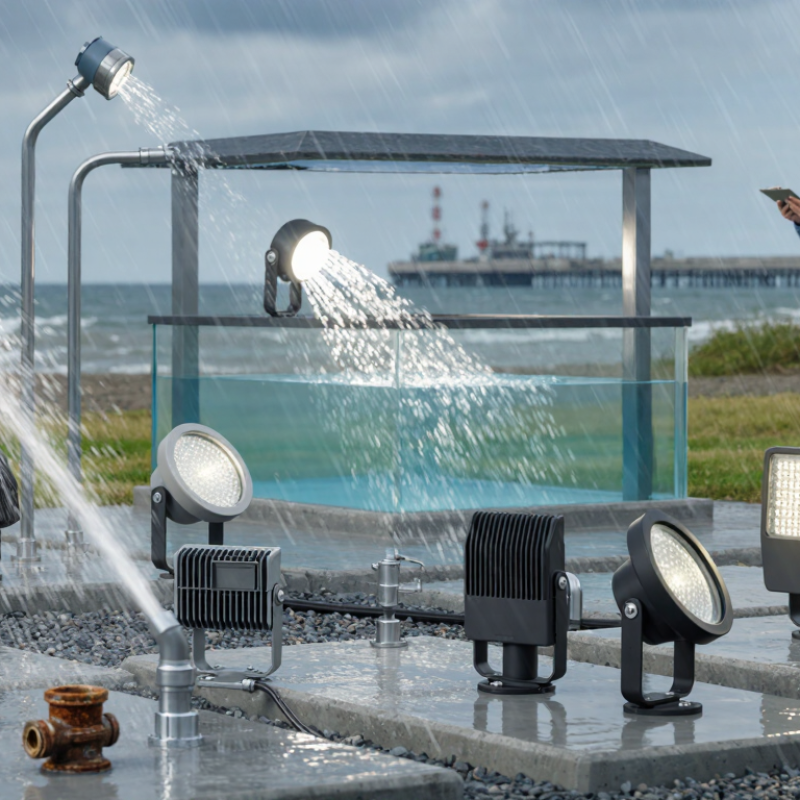
Choosing the right IP rating for outdoor lighting in 2026 requires more than selecting the highest number on the box. The rating follows IEC 60529 and measures protection against solids and water. It does not measure ultraviolet resistance, corrosion protection, impact strength, or electrical safety. That distinction matters beside a salty coastline, where moisture can attack seals and metal fittings.
So, what are the IP ratings for waterproof outdoor lighting? IP65 protects against dust and water jets. IP66 adds stronger water-jet protection. IP67 supports temporary immersion, while IP68 applies to continuous immersion under manufacturer-defined conditions. These ratings sound similar. They are not interchangeable. A fixture under a roof may need less water protection than one facing wind-driven rain in an exposed garden.
The U.S. Department of Energy reports that LED lighting can use at least 75% less energy than incandescent lighting and last up to 25 times longer. That efficiency only matters when the fixture survives its environment. The International Energy Agency also identifies efficient lighting as an important part of global electricity-saving strategies. However, an IP68 label cannot compensate for poor drainage, damaged cable glands, or careless installation.
A higher rating is not always the wiser choice. It may increase cost, restrict heat dissipation, or create false confidence. In practice, installers should examine rainfall, irrigation spray, flood risk, dust, salt, temperature changes, and maintenance access. Product test conditions can differ from real sites. That is the uncomfortable part. Good selection combines the IP code with verified test documentation, reputable components, and honest site assessment.
Understanding IP Ratings and Their Protection Levels
How to Choose the Right IP Rating for Outdoor Lighting 2026
Understanding IP Ratings and Their Protection Levels
An IP code describes protection against solid objects and water, not overall outdoor durability. IEC 60529 defines the test framework: the first digit measures solid-particle protection, while the second measures water ingress protection. For example, IP65 is dust-tight and tested against water jets. IP66 withstands more powerful jets, while IP67 covers temporary immersion under specified test conditions, commonly up to one metre for 30 minutes. These figures come from the standard’s test criteria, not a promise that every installation will face identical exposure.
Match the rating to the fixture’s real location. A sheltered porch may face occasional splashes; a low garden light can meet wet soil, sprinkler spray, and pooled water. Choose IP66 where strong washdown or driving rain is plausible, and consider IP67 where temporary immersion is a credible risk. But don’t treat a higher number as a complete solution. IEC 60529 does not rate resistance to salt corrosion, sunlight, temperature swings, or aging seals. Check the product’s installation instructions and inspect cable entries and gaskets after installation. A rating can look reassuring on paper. Site conditions are messier, and I’d leave room for that uncertainty.
Assessing Outdoor Conditions and Environmental Exposure
Outdoor conditions can change within a few metres. A fixture under a deep porch faces different exposure from one beside an open driveway. Before choosing an IP rating, observe where rain can blow, where water collects, and how often sprinklers reach the fitting. Look closely. A dry-looking wall may still receive wind-driven rain during storms.
An IP code describes resistance to dust or solid objects and water, but it does not explain every outdoor risk. Check the product’s specified test conditions and installation instructions. A fitting exposed to heavy spray needs different protection from one sheltered beneath an eave. Ground-level lights may also encounter splashes, wet soil, or pressure washing nearby. That last detail is easy to overlook. Do not assume a high rating makes a fixture suitable for every cleaning method or installation position.
Temperature swings, coastal salt, and airborne grit can affect durability without being captured by the IP number alone. Note these conditions, then confirm that the housing and materials are suitable for them. Consider cable entries and seals, too; a well-rated enclosure can be compromised by poor installation. If exposure is uncertain, inspect the site after rain or ask a qualified installer to assess it. The first estimate may be wrong, and that is worth checking.
Matching IP Ratings to Different Lighting Applications
Choosing an IP rating starts with the lighting location, not the fixture’s appearance. IP ratings follow IEC 60529, which measures protection against solids and water. A covered porch may need IP44 or IP54. An exposed wall light usually benefits from IP65, offering dust-tight protection and resistance to water jets. IP66 handles stronger jets, but it is not designed for permanent immersion.
Different applications need different protection. Garden bollards face rain, mud, and sprinklers, so IP65 is often a practical baseline. In-ground uplights may require IP67, which supports temporary immersion up to one metre under IEC test conditions. IP68 allows deeper or longer immersion only under manufacturer-defined conditions. That detail is easy to miss. Poolside lighting needs additional electrical safety controls; IP rating alone is not enough. The International Energy Agency reports that lighting uses about 15% of global electricity, so efficient, properly protected fixtures can reduce replacement waste and operating demand. However, an excessive IP rating may increase cost without improving real performance.
Tips: Inspect cable glands, seals, and drainage paths before installation. Do not treat IP67 as automatically suitable for underwater use. Recheck the rating after cutting cables or replacing connectors. The U.S. Department of Energy reports that LED lighting can use at least 75% less energy than traditional incandescent lighting, but poor installation can still shorten service life. Real sites are rarely perfect. Water may collect where drawings show none.
How to Choose the Right IP Rating for Outdoor Lighting 2026
Match the fixture’s ingress protection to its exposure to dust and water. These are typical starting points, not universal requirements.
The first IP digit indicates protection against solid particles; the second indicates protection against water. IP65 is dust-tight and protected against water jets, IP66 against powerful water jets, and IP67 against temporary immersion. For IP68, immersion conditions are specified by the manufacturer. Check the product rating, installation instructions, and local requirements for your site.
Balancing Safety, Durability, Installation, and Cost
How to Choose the Right IP Rating for Outdoor Lighting 2026
Choosing an IP rating is a balance, not a contest to buy the highest number. The first digit describes protection from solid objects, while the second indicates water resistance. For a sheltered porch, a lower water rating may be adequate if the fixture stays dry. An exposed path light faces wind-driven rain, splashes, and dust, so stronger protection can be worth the added cost. IP65 resists water jets; it does not mean a fixture is suitable for permanent immersion. Check the product’s installation instructions and intended location.
Installation matters just as much as the label. A well-rated fixture can still fail if water enters through a loose cable gland or poorly sealed connection. Keep joints clear of puddles, use compatible fittings, and allow drainage where the design requires it. In practice, the “best” rating can be hard to judge when a light sits under an overhang but still gets occasional spray. That uncertainty deserves a site-specific check.
Tips: Note whether the light faces rain, sprinklers, dust, or standing water. Match the rating to those conditions, then compare the full installed cost—not just the fixture price. Ask how seals and cable entries should be maintained. A higher rating may add expense without useful protection in a sheltered spot. Don’t guess. Check the manufacturer’s guidance, and reconsider if the actual installation differs from the stated conditions.
Verifying Compliance and Maintaining IP-Rated Fixtures
An IP mark is useful only when it matches the complete fixture and its installation. Check the test report or declaration for the exact model, not just a similar-looking product. Confirm that the stated rating applies with the specified cable glands, covers, and mounting position. Small changes matter. A missing gasket can leave water a path inside.
The first digit describes protection against solid objects; the second describes water resistance under defined test conditions. Neither promises protection from every storm, chemical, or aging seal. Compare the documentation with the site conditions and applicable local requirements. Keep records with the installation details. Paperwork is easy to lose.
Inspect fixtures when cleaning or servicing the area, and after severe weather if access is safe. Switch off power before opening any enclosure. Look for cracked lenses, loose glands, flattened seals, rust, or droplets behind the cover. Even slight fogging deserves attention. Clean surfaces with a soft cloth and mild cleaner; avoid pressure washing unless the manufacturer permits it. Replace damaged seals with the specified parts, then close the enclosure evenly. Honestly, maintenance intervals are often guessed. Set them from exposure, inspection findings, and service guidance, and revise them when the site proves harsher than expected.
FAQS
It measures protection against solid particles and water. The first digit covers solids. The second covers water.
Often, yes. IP65 is dust-tight and resists water jets. It suits exposed wall lights and many garden fixtures. Driving rain can still expose weak cable entries.
IP66 withstands stronger water jets. IP67 supports temporary immersion under specified conditions. That usually means up to one metre for 30 minutes. It is not permanent underwater approval.
No. IP ratings do not measure salt corrosion, sunlight, or temperature changes. They also do not guarantee long-lasting seals. The number looks reassuring. Real sites are messier.
IP67 may suit areas exposed to pooled water or temporary immersion. Check the exact installation instructions first. IP68 has manufacturer-defined conditions for deeper or longer immersion.
It may be suitable when exposure is limited to occasional splashes. IP54 can provide additional particle protection. Inspect the ceiling, walls, and drainage before deciding.
Confirm the rating for the complete fixture and exact model. Check cable glands, gaskets, covers, and mounting position. A missing gasket creates a water path. Small changes matter.
Inspect them during cleaning and after severe weather, if access is safe. Switch off power before opening any enclosure. Look for cracked lenses, loose glands, rust, or droplets. Even slight fogging deserves attention. Maintenance intervals are partly guesswork. Revise them when conditions prove harsher.
Conclusion
Choosing the right IP rating for outdoor lighting starts with understanding how the two digits describe protection against solid particles and water. What are the IP ratings for waterproof outdoor lighting? The right choice depends on where and how a fixture will be used, since a sheltered porch has different exposure from an open garden, a coastal area, or a spot subject to direct water spray. Consider rain, dust, humidity, temperature changes, and the possibility of temporary immersion before selecting a rating.
Match the rating to the application while balancing protection with safety, durability, installation needs, and cost. A higher rating is not automatically necessary for every location, but inadequate protection can shorten a fixture’s service life. Check product documentation and relevant certification details, and ensure installation preserves the fixture’s seals and cable entries. Periodic inspection and maintenance can help identify damage or worn seals, keeping outdoor lighting reliable over time.
 Suvlux Light
