How to Protect Outdoor LED Lights From Lightning Strikes?

Time:2026-09-19 Author:Sophia
0%

Outdoor LED lighting improves safety, visibility, and landscape appeal, but exposed fixtures face serious electrical risks during thunderstorms. A nearby strike can send a powerful surge through underground cables, control systems, or metal mounting poles. Direct strikes are less common, yet their damage can be immediate. Drivers may fail, lenses can crack, and wiring insulation may burn.

So, how to protect outdoor LED lights from lightning strikes? Effective protection begins with a complete system, not a single device. Proper grounding and bonding create a safer path for fault energy. Surge protective devices can limit voltage spikes at the electrical panel and near sensitive LED drivers. Weatherproof junction boxes, correctly rated cables, and sealed connections also reduce secondary damage. Installation should follow applicable local electrical codes and manufacturer instructions. A qualified electrician should verify the grounding system before outdoor lighting is energized.

Small details matter.

For example, a loose ground connection hidden inside a damp junction box may remain unnoticed until the first severe storm. Regular inspections should check corrosion, cracked seals, exposed conductors, and tripped surge protectors. Photocells, timers, smart controllers, and low-voltage transformers deserve attention too. They often fail before the visible lamp does.

Protection is not absolute. No grounding method can guarantee survival after a direct strike. This is where many installation plans become too optimistic. Layered protection, careful maintenance, and realistic risk assessment offer stronger results. The following guide explains practical choices, common mistakes, and ways to improve outdoor LED lighting resilience without relying on one solution alone.
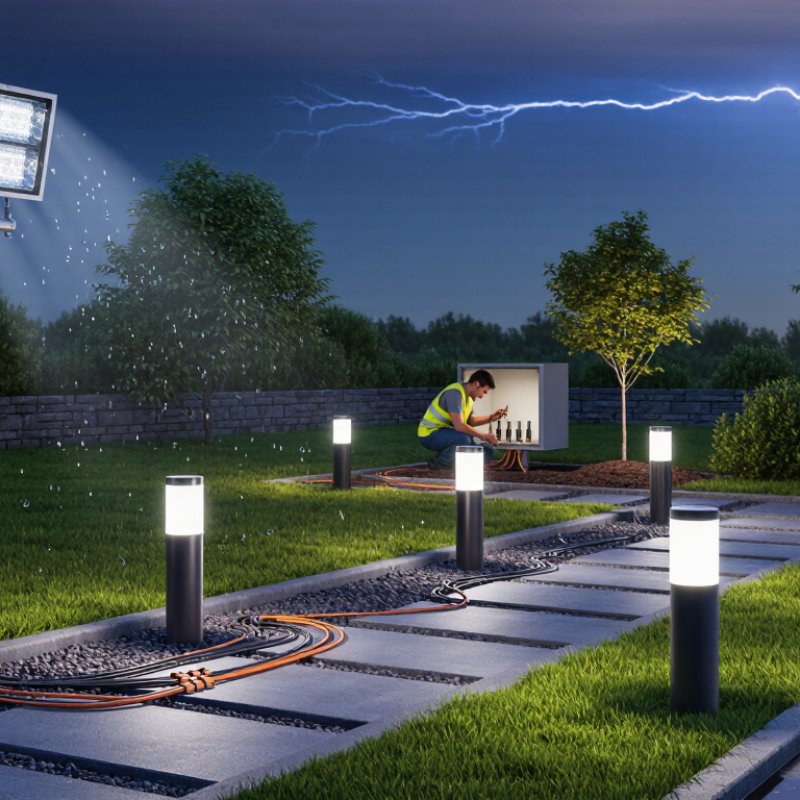
How to Protect Outdoor LED Lights From Lightning Strikes?

Assess Lightning Risks Around Outdoor LED Lighting

Assessing Lightning Risk Around Outdoor LED Lighting

Assessing lightning risk around outdoor LED lighting begins with location, not wattage. Lightning can enter through power, control, and long metal runs. NOAA’s National Severe Storms Laboratory estimates that the United States experiences about 25 million lightning flashes annually. That number hides local differences. Coastal towers, open sports fields, high rooftops, and exposed parking areas face different strike patterns. The 2023 Annual Lightning Report from a global lightning detection network recorded about 1.39 billion lightning events worldwide. A regional average may still miss a dangerous microclimate. Check historical strike maps, local thunderstorm records, elevation, nearby trees, poles, and fixture height. Measure cable routes. Long outdoor cables can collect induced surges, even without a direct strike.

IEC 62305-2 considers lightning frequency, structure dimensions, occupancy, and failure consequences during risk assessment. For LED systems, include driver location, grounding continuity, surge protective device placement, and metallic structures. A short bonding jumper is usually more dependable than a long, tidy route. Keep inspection records. Look for cracked insulation, corroded terminals, water inside junction boxes, and repeated driver failures after storms. These clues matter. One mistake is treating a surge protector as a complete lightning solution. It is not. Its rating, coordination, earthing path, and maintenance affect performance. I have seen assessments rely too heavily on regional maps. That feels efficient, but it can overlook one raised fixture beside an open field. Reassess after layout changes, new poles, drainage work, or repeated storm damage.

How to Protect Outdoor LED Lights From Lightning Strikes?

Assess Lightning Risks Around Outdoor LED Lighting

This qualitative engineering assessment uses a 1–5 relative risk scale. Exposed metal poles, long outdoor cable runs, isolated structures, and poor grounding increase the likelihood that lightning-induced surge energy will reach LED drivers. Use coordinated surge protective devices, bonding, grounding, and short cable routes to reduce risk.

Install Grounding and Bonding for a Safe Electrical Path

Lightning can destroy outdoor LED lights through direct strikes or voltage surges traveling along cables. Grounding and bonding create a safer path for unwanted electrical energy. They do not make a lighting system lightning-proof.

A qualified electrician should connect the fixture, metal junction boxes, conduit, and control equipment to the grounding system. Every connection must be tight, corrosion-resistant, and suitable for outdoor exposure. The grounding conductor should run continuously where possible. Avoid relying on painted surfaces, loose screws, or buried metal parts with unknown connections.

Bonding matters too. It keeps exposed metal parts at nearly the same electrical potential, reducing dangerous voltage differences during a surge. Installations should follow local electrical codes and be checked with proper test instruments. De-energize the circuit before inspection.

Surge protection can add another layer. A suitable device at the electrical panel may limit transient voltage before it reaches the lights. Long cable runs may need additional protection near the fixtures. Keep cables away from sharp edges and water-collecting areas.

Small details matter.

During inspections, a tidy installation can still hide a weak ground connection. That is an easy mistake to miss. Check for oxidation, damaged insulation, loose terminations, and missing bonding jumpers after severe storms. Document test results and repair problems promptly. No grounding method can guarantee protection from a direct lightning strike, but a carefully bonded system can reduce equipment damage and improve safety.

How to Protect Outdoor LED Lights From Lightning Strikes? — Install Grounding and Bonding for a Safe Electrical Path

Protection Dimension Recommended Practice Installation Detail Verification Check Reference or Technical Basis
Equipment grounding conductor Provide a continuous, permanent grounding path from each outdoor LED fixture and driver enclosure back to the supply grounding point. Use an approved copper or aluminum equipment grounding conductor sized according to the applicable electrical code and the circuit overcurrent protection. Required
Confirm continuity from the fixture enclosure to the grounding terminal.
Electrical safety codes require exposed conductive parts to be connected to an effective ground-fault current path.
Bonding of metal parts Bond metal light poles, mounting brackets, junction boxes, driver enclosures, handrails, and nearby metal raceways that could become energized. Use listed bonding jumpers, terminals, or fittings. Remove paint, oxidation, and coatings where the bonding connection is made, unless the fitting is designed for coated surfaces. Required
Check that every accessible metal section has a low-resistance connection to the grounding path.
Bonding keeps interconnected metal parts at substantially the same electrical potential during a fault or surge.
Grounding electrode system Connect the outdoor lighting system, service equipment, and applicable structures to the grounding electrode system required by the local code. Use the available electrodes in accordance with local requirements, such as building steel, concrete-encased electrodes, metal water pipe electrodes, or ground rods. Inspect
Verify electrode connections are accessible, protected from mechanical damage, and corrosion-resistant.
Grounding electrode requirements vary by electrical system and jurisdiction; a single ground rod is not universally sufficient.
Ground rod arrangement Do not assume that one ground rod provides an adequate grounding electrode system. Where a rod does not meet the applicable measured-resistance requirement, install an additional electrode as required by the governing code. Maintain the code-required spacing and interconnection. Measure
Use the testing method required by the authority having jurisdiction; do not use a generic resistance target for every installation.
Grounding electrode performance depends on soil, electrode type, spacing, moisture, and local code provisions.
Surge protective device at the distribution point Install a properly rated surge protective device at the panel or disconnect supplying the outdoor LED circuit. Keep connecting conductors short and straight, follow the device wiring diagram, and connect the surge device to the grounding and bonding system. Recommended
Check the device status indicator and inspect the protective device after a known major surge or lightning event.
SPDs reduce transient overvoltage but do not guarantee protection from a direct lightning strike.
Surge protection at sensitive equipment Protect LED drivers, control cabinets, dimmers, photocells, network interfaces, and other equipment located downstream or outdoors. Use coordinated protection at the equipment location when conductor length, system layout, or exposure creates additional surge risk. Recommended
Confirm voltage, frequency, system configuration, and surge ratings match the equipment and circuit.
Multiple protection points can reduce the voltage stress reaching sensitive electronic components.
Cable routing and separation Route power, control, and data cables to minimize large loops and avoid unnecessary parallel runs with lightning down conductors. Use suitable metallic raceways or shielded cabling where required, and bond metallic raceways at both ends when required by the installation method. Inspect
Look for long loops, damaged insulation, unbonded raceways, and cables crossing lightning protection conductors unnecessarily.
Inductive coupling from nearby lightning current can introduce damaging transient voltages into cable loops.
Lightning protection system integration Coordinate outdoor LED grounding and bonding with any building or site lightning protection system. Do not create isolated grounding systems that can develop dangerous potential differences. Follow the lightning protection designer’s bonding and separation requirements. Specialist
Have the complete system reviewed where a formal lightning protection system is present or required.
Lightning protection, grounding, bonding, and surge protection must be coordinated as one system.
Ingress protection and enclosure sealing Use outdoor-rated fixtures, drivers, junction boxes, and cable glands suitable for the site environment. IP65 indicates protection against dust and water jets; IP66 indicates protection against dust and more powerful water jets. Neither rating provides lightning protection. Inspect
Check gaskets, cable glands, drain paths, covers, and enclosure damage during maintenance.
Ingress protection helps prevent moisture-related faults, while grounding and surge protection address electrical hazards.
Inspection and maintenance interval Inspect the system periodically and after severe storms, construction work, equipment replacement, or a suspected surge event. Examine grounding connections, bonding jumpers, SPD indicators, corrosion, loose terminals, damaged insulation, and water ingress. Periodic
Record inspection dates, test results, defects, and corrective actions.
Connections can loosen or corrode over time, reducing the effectiveness of the intended fault and surge paths.
Qualified installation and testing Use a qualified electrician or lightning protection professional for design, installation, testing, and code compliance. Follow the applicable national and local electrical codes, manufacturer instructions, and lightning protection standards for the site. Essential
Obtain required permits, inspections, and test documentation where applicable.
Grounding and lightning protection design depends on the supply system, soil conditions, site geometry, and local regulations.

Safety note: This table provides general technical guidance. Final conductor sizing, electrode selection, SPD ratings, separation distances, and testing procedures must be determined according to the applicable electrical code and site conditions.

Add Surge Protection Devices to LED Lighting Circuits

Outdoor LED lights are exposed to long cable runs, wet ground, and nearby lightning activity. A surge can enter through power lines, even when lightning does not strike the fixture directly. Surge protection devices help divert this sudden voltage away from sensitive LED drivers.

Install a suitable SPD at the lighting circuit’s distribution panel. For large outdoor systems, an additional device near the LED fixtures can reduce residual voltage. The SPD must match the system voltage, grounding arrangement, and expected surge environment. Its grounding conductor should be short, straight, and securely bonded. Long loops reduce protection performance.

Use a weather-resistant enclosure where moisture may reach the device. A qualified electrician should verify conductor size, breaker coordination, and local electrical requirements. In field inspections, loose grounding connections often cause more concern than the SPD rating itself. Check the indicator after severe storms. Replace the device if it shows failure.

Small details matter. Keep cables tidy. Avoid sharp bends. Protect exposed connections from water. A design may look correct on paper, yet installation weaknesses can remain hidden inside a junction box. I have seen outdoor lights fail because the protection device was installed, but poorly bonded. No device can guarantee survival against a direct strike. Regular inspection remains necessary.

Improve Wiring, Enclosures, and Structural Protection

Outdoor LED lights need more than weather-resistant housings during thunderstorms. Wiring is the first weak point. Use outdoor-rated cable inside continuous conduit, and keep connections above standing water. Install a properly grounded surge protective device near the lighting circuit. A second device at the distribution panel can add protection for long cable runs. Leave a small drip loop below each entry point. Water should fall away, not travel into the enclosure.

Enclosures must resist rain, condensation, and pressure changes. Choose a suitable outdoor protection rating, then inspect every gasket, screw, and cable gland. A sealed box is not automatically safe. Condensation can still collect inside after a cold night.

I have seen corrosion begin around one poorly tightened gland. Keep junction boxes accessible for inspection, but never place them beneath roof edges where runoff concentrates. All grounding and bonding work should be checked by a qualified electrician and follow local electrical requirements.

Tips: Keep light fixtures away from the highest exposed points of a structure. Reinforce brackets against wind movement, which can loosen connections over time. Bond accessible metal supports when the design requires it. For tall poles or large installations, consult a lightning protection professional before installation. Do not rely on unplugging alone during severe weather. It reduces one path, but it may not protect long outdoor wiring. A careful design helps. No system can promise complete immunity from a direct strike.

Inspect and Maintain Lightning Protection Components Regularly

Outdoor LED lights need more than sealed housings to withstand lightning. Their protection system must be inspected regularly, especially after severe weather. Check air terminals for bending, cracks, or missing fasteners. Examine down conductors for cuts, loose clips, and sharp bends. Even small gaps can reduce the intended path to ground.

Inspect bonding connections near poles, junction boxes, and metal support structures. Look for rust, heat marks, water entry, or damaged insulation. Grounding electrodes should remain secure and free from serious corrosion. A qualified electrician should test continuity and grounding performance with suitable instruments. Visual checks alone can miss hidden resistance problems.

Surge protective devices also require attention. Confirm that indicators show normal operation and replace any unit that has operated or suffered damage. Check cable glands and enclosure seals after storms. Moisture can quietly weaken connections.

Keep dated inspection records, including photographs and test results. This helps reveal repeated failures at one location.

A checklist helps, but it is not perfect. Maintenance crews may overlook buried connections or assume that an intact light means intact protection. That assumption needs review.

Inspect before the storm season, after a direct strike, and whenever lights flicker or fail unexpectedly. Repairs should follow local electrical requirements and be performed by trained personnel. Safety comes before restoring illumination.

FAQS

What factors determine lightning risk for outdoor LED lighting?

Location matters more than wattage. Check nearby poles, trees, rooftops, open fields, elevation, and fixture height. Review local storm history. Measure long cable routes. A small exposed fixture can still face serious risk.

Can lightning damage lights without a direct strike?

Yes. Surges can travel through power, control, and metal cables. Long outdoor wiring can also collect induced surges. Distance alone is not enough protection.

Does grounding make an LED lighting system lightning-proof?

No. Grounding creates a safer path for unwanted electrical energy. It cannot guarantee protection from a direct strike. The result depends on continuity, connections, and maintenance.

Which parts should be grounded and bonded?

A qualified electrician should connect fixtures, metal boxes, conduit, control equipment, and suitable supports. Bond exposed metal parts when the design requires it. Avoid painted surfaces and loose screws.

Where should surge protection be installed?

Install suitable protection near the lighting circuit. Long cable runs may need another device near the fixtures. Correct ratings, coordination, earthing, and maintenance all matter.

How can wiring reduce storm damage?

Use outdoor-rated cable inside continuous conduit. Keep connections above standing water. Add a small drip loop below each entry point. Keep cables away from sharp edges.

What enclosure problems should inspections find?

Check gaskets, screws, cable glands, and condensation marks. Look for cracked insulation, corrosion, water, and loose terminals. A sealed box is not automatically safe.

When should an outdoor lighting system be reassessed?

Reassess after adding poles, changing layouts, completing drainage work, or experiencing repeated storm damage. Record test results and repairs. A tidy installation can still hide a weak connection.

Should fixtures be placed at the highest exposed points?

Avoid the highest exposed locations where practical. Reinforce brackets against wind movement. Tall poles and large systems may need professional lightning protection advice. This detail is easy to overlook.

Conclusion

Protecting outdoor LED lighting from lightning begins with understanding the risks around each installation. Factors such as local storm frequency, exposed locations, tall structures, nearby trees, and long cable runs can increase the chance of lightning-related damage. To answer the question, “How to protect outdoor LED lights from lightning strikes?”, create a safe path for electrical energy by properly grounding and bonding the fixtures, poles, junction boxes, and other conductive parts. A complete grounding system helps reduce dangerous voltage differences during a storm.

Surge protection devices should also be installed on suitable LED lighting circuits to limit sudden voltage spikes. Durable, weather-resistant enclosures, correctly rated wiring, sealed connections, and protected cable routes can further reduce exposure to moisture and electrical stress. Structural protection, such as placing lights away from highly exposed points when practical, may provide additional safety. Finally, inspect grounding connections, surge protectors, wiring, and enclosures regularly, especially after severe weather, and replace damaged components promptly to keep the lighting system reliable.

Sophia

Sophia

Sophia is a dedicated marketing professional with an exceptional depth of knowledge about her company's products and services. With a keen understanding of market trends and customer needs, she crafts insightful blog posts that not only inform but also engage readers, enriching the company’s online......